
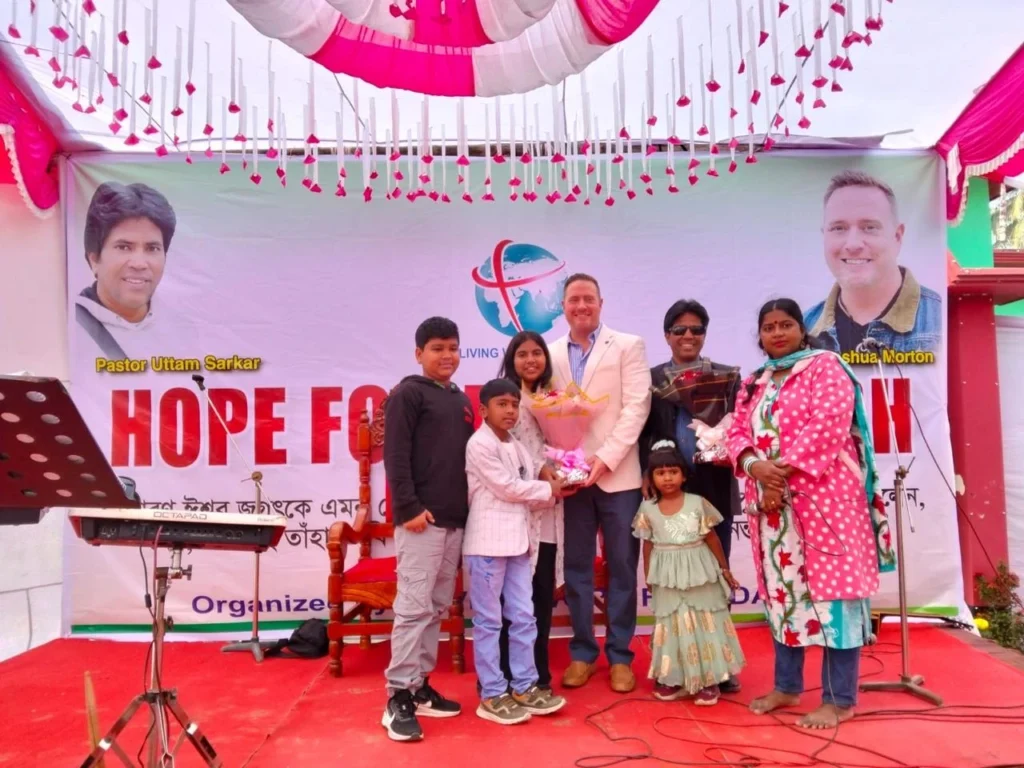
Christian ministry in Bangladesh can look very different from ministry in the United States or other Christian-majority settings.
Bangladesh is a densely populated South Asian country where Islam is the dominant religion and Christians represent only a small minority. Christian communities exist throughout the country, but churches, pastors, and ministry resources are not distributed evenly. Some believers worship in established churches, while others gather in homes or smaller Christian communities. In areas with little Christian presence, ministry may begin through personal relationships, Bible study, prayer, discipleship, or the work of a local pastor.
For Living Word Foundation, Christian ministry in Bangladesh is centered on supporting local believers and leaders who understand the communities they serve. Rather than viewing ministry as a short-term foreign project, the goal is to strengthen evangelism, discipleship, Scripture access, pastoral leadership, and Christian communities that can continue growing over time.
Christianity Is a Small Minority in Bangladesh
Understanding Christian ministry in Bangladesh begins with understanding the country’s religious context.
According to the U.S. Department of State’s reporting on Bangladesh, the 2022 national census found that approximately 91% of the country’s population is Muslim and roughly 8% is Hindu. Christians represent only a small portion of the remaining population. The report also notes that Bengali and ethnic-minority Christian communities can be found across Bangladesh, including in Dhaka, Gazipur, Khulna, Barishal, Gopalganj, and Mymensingh. U.S. Department of State: Religious Freedom in Bangladesh
This means Christian ministry does not occur in a completely Christian-free country. Bangladesh already has churches, pastors, denominations, Christian families, schools, and ministries.
However, access to those Christian communities varies considerably.
A person may live near an established church, while someone in another village or ethnic community may have little meaningful contact with Christians at all.
That uneven access helps explain why Christian ministry in Bangladesh often focuses not only on the country as a whole but also on individual communities and people groups.
Evangelism Often Begins With Relationships
When people imagine missionary work, they may picture large evangelistic gatherings or public preaching.
Those activities can be part of Christian missions, but much ministry in Bangladesh can be more relational.
A Christian may begin by building a friendship with someone.
A neighbor may ask a question about Jesus.
A family may become curious about Christianity after interacting with local believers.
Someone may begin reading Scripture with a Christian friend.
Over time, those conversations can develop into deeper discussions about faith.
This relational approach is especially important when religion is closely connected with family and community identity.
The U.S. Department of State has reported that while Bangladesh’s constitution protects the right to profess, practice, and propagate religion, some converts to Christianity have experienced social isolation, threats, harassment, or violence. Experiences vary significantly by community, but these realities help explain why ministry requires sensitivity and trust. Read the Bangladesh Religious Freedom Report
For Living Word Foundation, this is one reason local Christian leaders are so valuable. They understand the relationships, expectations, and sensitivities within the communities where ministry takes place.
Local Pastors Are Central to Ministry
One of the clearest examples of what Christian ministry looks like in Bangladesh is the work of local pastors.
Pastors do much more than preach on Sundays.
They may:
- Teach the Bible
- Lead prayer gatherings
- Disciple new believers
- Visit families
- Counsel church members
- Encourage Christians facing hardship
- Lead evangelistic outreach
- Train emerging leaders
- Organize children’s ministry
- Coordinate assistance for families in need
- Help establish new Christian gatherings
Their ministry is relational and ongoing.
A foreign ministry team may visit Bangladesh for a short period, but a local pastor remains within the community before and after that visit.
That continuity matters.
When someone first becomes interested in Christianity, a local pastor can continue answering questions.
When a believer faces a difficult family situation, local leaders can provide support.
When Christians need teaching or encouragement months later, the pastor is still there.
Living Word Foundation therefore seeks to strengthen indigenous Christian leadership in Bangladesh, recognizing that local leaders are often best positioned to sustain ministry over the long term.
Discipleship Is a Major Part of Christian Ministry
Evangelism is only the beginning.
Christian ministry also involves helping people understand and live out their faith.
Jesus’ instruction in Matthew 28:19-20 calls Christians to make disciples, not merely to create brief moments of religious interest.
Discipleship may involve one-on-one conversations, small Bible studies, church teaching, prayer, mentoring, or regular gatherings with other believers.
A new Christian may need help understanding basic questions:
Who is Jesus?
How should I read the Bible?
What does Christian prayer look like?
What does forgiveness mean?
How should faith shape everyday life?
Why should Christians gather together?
How can I explain my beliefs to family members?
These questions require time.
That is why Living Word Foundation’s approach to Christian ministry in Bangladesh emphasizes long-term discipleship alongside evangelism.
The goal is not simply for someone to hear the Gospel once. It is for believers to grow in their faith and eventually become capable of discipling others.
Bible Access and Teaching Matter
Access to Scripture is another important part of Christian ministry.
A Bible can provide a foundation for personal faith, discipleship, teaching, and church growth.
But simply distributing Bibles is not enough.
People also need help understanding what they read.
Local pastors and Christian teachers can guide believers through Scripture, explain difficult passages, answer questions, and help people apply biblical teaching to their lives.
Christian ministry may therefore involve providing Bibles, discipleship resources, teaching materials, and other tools that local leaders can use.
Living Word Foundation seeks to support the kind of ministry infrastructure that allows Christian leaders to continue teaching long after an outside partner has gone home.
House Churches and Small Christian Gatherings
Not every Christian community in Bangladesh gathers in a large church building.
In some areas, believers may meet in homes or modest community spaces for prayer, worship, Bible study, and fellowship.
Small gatherings can be particularly important where the Christian population is limited.
They may begin with only a handful of people.
Over time, a small group can become a stable Christian community.
A believer learns Scripture.
That believer begins discipling someone else.
Another family joins.
A local leader emerges.
Eventually, that community may begin reaching neighboring families or villages.
This gradual process is one way sustainable Christian ministry can grow without depending entirely on large facilities or outside leadership.
Ministry Among Unreached People Groups
Bangladesh is particularly significant within global missions because of the number of communities that mission researchers classify as unreached.
Joshua Project currently tracks 277 people groups in Bangladesh and classifies 255 of them as unreached, or about 92% of the groups in its database. It estimates that approximately 98.9% of the country’s population lives within groups it categorizes as unreached. Joshua Project: Bangladesh People Groups
Those numbers are mission-research estimates rather than official government census classifications, and Joshua Project cautions that its data comes from multiple sources and should be understood as approximate.
Still, the data highlights an important reality.
Having Christian churches somewhere in Bangladesh does not necessarily mean every cultural or ethnic community has meaningful access to Christian teaching.
Ministry among these communities may require different languages, different relationships, and different approaches.
This is another reason a locally led strategy is so important.
Compassionate Ministry Can Serve Practical Needs
Christian ministry can also include helping families facing practical challenges.
Churches and ministries may encounter people dealing with poverty, educational barriers, natural disasters, health needs, or other hardships.
Christian service can respond to these needs through acts of compassion.
Depending on the community, this may involve:
- Educational support
- Children’s programs
- Food assistance
- Emergency relief
- Support for vulnerable families
- Ministry facilities
- Practical help coordinated through local churches
Compassionate ministry should never make assistance dependent on conversion.
Christian service should be offered because Christians are called to love their neighbors, not as leverage to pressure someone into changing their faith.
When practical ministry is coordinated through trustworthy local Christian leaders, it can also help ensure that resources address actual community needs rather than needs assumed by outsiders.
Christian Education Can Support Long-Term Ministry
Education can play an important role in Christian ministry as well.
This may include children’s Bible teaching, literacy, discipleship materials, Christian education, or helping families access learning opportunities.
The U.S. Department of State notes that Christian institutions have a longstanding role in education in Bangladesh, including hundreds of schools operated by the Catholic Church.
Within local ministry, education can also help children and adults develop skills while giving churches opportunities to build meaningful relationships with families.
For Living Word Foundation, education can complement evangelism and discipleship when it is approached as genuine service to communities rather than merely as a vehicle for conversion.
Prayer Is Part of Everyday Ministry
Christian ministry cannot be reduced entirely to visible programs.
Prayer is a major part of Christian life and ministry.
Local Christians may pray for:
- Families in their communities
- New believers
- Pastors
- Unreached people groups
- Opportunities to share the Gospel
- Churches facing difficulty
- Children and families
- New ministry leaders
- Neighboring villages
- Spiritual growth
Churches outside Bangladesh can also participate in ministry through informed and consistent prayer.
Rather than simply praying for “Bangladesh” in general, churches can learn about specific communities, pastors, ministry needs, and people groups.
That makes prayer more connected to the realities of the Christians serving there.
Training Leaders Helps Ministry Multiply
One of the most important forms of Christian ministry is developing future leaders.
A healthy church cannot depend on one pastor forever.
Leaders need to train other leaders.
A pastor may disciple a younger Christian who eventually begins teaching Scripture.
A Bible-study leader may mentor someone who later leads another group.
A mature believer may begin discipling new Christians.
Eventually, those leaders may carry ministry into another village or community.
This creates multiplication.
Instead of foreign organizations continually providing all the leadership, Bangladeshi Christians become increasingly equipped to lead, teach, evangelize, and disciple others themselves.
That is one of the most sustainable outcomes Christian missions can pursue.
What Outside Mission Partners Should Do
Churches and ministries outside Bangladesh still have an important role.
They can provide:
- Prayer
- Financial support
- Bibles
- Discipleship resources
- Training
- Pastoral support
- Educational resources
- Ministry facilities
- Emergency assistance
- Encouragement and long-term partnership
But the question should not simply be:
What can we go to Bangladesh and do?
A better question is:
What are Bangladeshi Christian leaders already doing, and how can we help strengthen that work?
That mindset changes missions from outside control to genuine partnership.
What Christian Ministry in Bangladesh Ultimately Looks Like
Christian ministry in Bangladesh does not have one single form.
It can look like a pastor teaching Scripture in a small church.
It can look like several families gathering in a home to pray.
It can look like a Christian explaining the Gospel to a friend.
It can look like a new believer meeting regularly with a mature Christian for discipleship.
It can look like a child receiving education, a family receiving practical support, or a pastor receiving resources that help him continue serving his congregation.
It can also look like one local Christian leader training another so that ministry continues multiplying.
For Living Word Foundation, sustainable Christian ministry in Bangladesh means working alongside those local Christians rather than replacing them.
The goal is to help strengthen evangelism, biblical discipleship, local churches, Scripture access, Christian leadership, and outreach to communities with limited exposure to the Gospel.
Bangladesh’s ministry needs are significant. Joshua Project’s current research classifies 255 of the 277 people groups it tracks in the country as unreached.
But numbers alone do not define the mission.
Christian ministry happens through people.
It happens through relationships, faithful pastors, growing disciples, local churches, prayer, Scripture, compassion, and Christians willing to serve their communities over the long term.
That is what sustainable Christian ministry in Bangladesh ultimately looks like.